
BREAST CANCER
- Mar 9
- 3 min read
It is the malignant growth in the breast tissues commonly occur in the female breast and infrequently in the male breast.
🔷 Incidence: Breast cancer is the most common cancer in females and it is second only after to lung cancer as the leading cause of death from cancer in females.
The risk of developing breast cancer increases with increasing age. It is commonly seen in women 55 years or older.
🔷 ETIOLOGY AND RISK FACTOR
Sex: It is more commonly found in females, and infrequent in males.
History of ovarian cancer
Family history (First degree relatives with breast cancer like mother sister, daughter)
Genetic mutation (BRCA 1 and BRCA 2 mutation)
Early menarche (Before 12 years of age)
Late menopause (after 55 years of age)
Nulliparity (No full term pregnancies)
Late age at first full term pregnancy (after 30 years of age.)
Hormonal therapy (long term use of oral contraceptives or HRT)
Exposure to ionizing radiation during adolescence and early adulthood.
Benign or precancerous growth of breast
Obesity and high fat diet.
Alcohol consumption
Ovarian-Pituitary dysfunction.
High socioeconomic status.
Previous history of other reproductive organ cancer like ovary, uterus etc.
🔷 TYPE OF BREAST CANCER
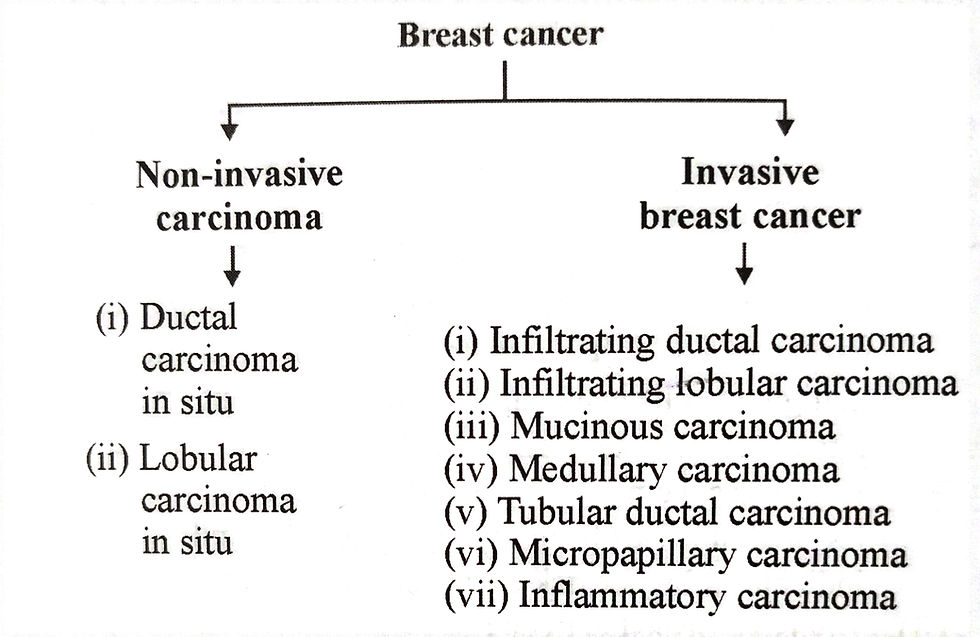
( A ) Non-Invasive Carcinoma
Non-invasive means the cancer cells remain in their original place and do not spread to surrounding breast tissue.
(i) Ductal Carcinoma In Situ (DCIS)
Cancer begins in the milk ducts.
Cells stay inside the duct and do not invade nearby tissue.
It is considered an early stage (Stage 0) breast cancer.
With proper treatment, the prognosis is very good.
(ii) Lobular Carcinoma In Situ (LCIS)
Abnormal cells develop in the lobules (milk-producing glands).
It usually does not spread, but it increases the risk of developing breast cancer later.
Often found during breast biopsy.
( B ) . Invasive Breast Cancer
Invasive means the cancer spreads beyond the ducts or lobules into surrounding breast tissue and may spread to lymph nodes or other organs.
(i) Infiltrating Ductal Carcinoma
The most common type of breast cancer.
Starts in the ducts and spreads into nearby breast tissue.
(ii) Infiltrating Lobular Carcinoma
Starts in the lobules and spreads to surrounding tissue.
The second most common type.
(iii) Mucinous Carcinoma
Cancer cells produce mucus (gel-like substance).
Usually slow growing and has a better prognosis.
(iv) Medullary Carcinoma
A rare type of breast cancer.
Tumor is usually soft and well defined.
Sometimes associated with genetic mutations.
(v) Tubular Carcinoma
Cancer cells form tube-shaped structures.
Usually small and slow growing.
Prognosis is generally good.
(vi) Micro papillary Carcinoma
Rare and more aggressive type.
Often spreads to lymph nodes.
(vii) Inflammatory Breast Cancer
A very aggressive and rare type.
Causes redness, swelling, warmth, and thick skin (orange-peel appearance).
Usually spreads quickly.
🔷 CLINICAL MANIFESTATIONS
Breast lump (painless, hard)
Change in breast size or shape
Skin dimpling or orange-peel appearance
Nipple retraction or inversion
Nipple discharge (sometimes bloody)
Breast pain or tenderness
Swelling of axillary lymph nodes
Redness and warmth of breast (seen in Inflammatory Breast Cancer)
🔷 DIAGNOSIS
Breast self examination
Breast examination by inspection and palpation
Mammography
Ultrasonography
Magnetic Resonance Imaging (MRI)
Fine Needle Aspiration Biopsy (FNAC)
Open biopsy such as excisional biopsy or incisional biopsy
Chest X-Ray, abdominal ultrasound and CT scan are also done to detect metastasis.
🔷 TREATMENT
1. Surgery
Surgery is the main treatment to remove the cancer.
Lumpectomy: Only the tumor and a small amount of surrounding tissue are removed.
Mastectomy: The entire breast is removed if cancer is large or widespread.
Sometimes axillary lymph nodes are also removed to check spread.
2. Chemotherapy
Uses anticancer drugs to destroy cancer cells.
Can be given before surgery (to shrink tumor) or after surgery (to kill remaining cancer cells).
Given through IV injection or tablets.
3. Radiation Therapy
Uses high-energy rays to destroy cancer cells.
Usually given after surgery to prevent cancer from coming back.
Treatment is given in small doses over several weeks.
4. Hormone Therapy
Some breast cancers grow due to hormones like estrogen or progesterone.
Hormone therapy blocks these hormones and slows cancer growth.
Common drugs are tamoxifen or aromatase inhibitors.
Comments