
Cell Structure and Cell Division
- May 6, 2025
- 2 min read
🧬 1. Introduction
Cells are the basic structural and functional units of life. All living organisms are made up of cells. Understanding cell structure and cell division is essential in nursing to comprehend how the human body grows, heals, and functions at the microscopic level.
PART 1: CELL STRUCTURE
🔬 2. Definition of a Cell
A cell is the smallest unit of life capable of performing all vital physiological functions.Human body has about 37.2 trillion cells, varying in size, shape, and function.
🧫 3. Types of Cells
Type | Description |
Prokaryotic | Simple cells without a nucleus (e.g., bacteria) |
Eukaryotic | Complex cells with a true nucleus and membrane-bound organelles (e.g., human cells) |
🧠 Human cells are eukaryotic.
🧩 4. Structure of a Generalized Animal Cell
Cell Organelle | Function |
Cell membrane (Plasma membrane) | Protects the cell, controls what enters and exits |
Cytoplasm | Jelly-like fluid where organelles are suspended |
Nucleus | Control center of the cell; contains DNA |
Nucleolus | Produces ribosomes |
Endoplasmic Reticulum (ER) |
Rough ER: Protein synthesis (has ribosomes)
Smooth ER: Lipid and hormone synthesis
| Ribosomes | Protein synthesis
| Golgi Apparatus | Packaging and transport of proteins
| Mitochondria | Powerhouse of the cell; produces ATP (energy)
| Lysosomes | Digests waste materials and worn-out cell parts
|Centrioles | Help in cell division
| Vacuoles | Storage of nutrients, waste
| Cytoskeleton | Maintains cell shape and allows movement

🌐 5. Cell Membrane Transport Mechanisms
Type | Description | Example |
Diffusion | Movement of molecules from high to low concentration | O₂/CO₂ exchange in lungs |
Osmosis | Movement of water through semi-permeable membrane | Absorption in kidneys |
Active Transport | Requires energy (ATP); moves substances against gradient | Sodium-potassium pump |
PART 2: CELL DIVISION
🔄 6. Importance of Cell Division
Growth and development
Repair and regeneration
Reproduction (in gametes)
Maintenance of genetic information
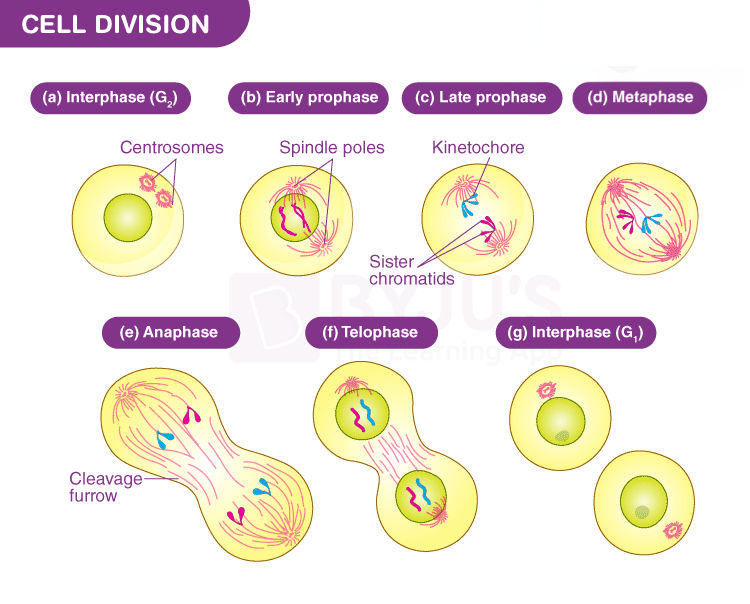
🧪 7. Types of Cell Division
Type | Purpose | Occurs In | Result |
Mitosis | Growth & repair | Somatic (body) cells | 2 identical diploid daughter cells |
Meiosis | Reproduction | Sex cells (gametes) | 4 non-identical haploid cells |
📚 8. Phases of Mitosis (PMAT)
Mitosis = One division → 2 identical daughter cells (Diploid)
Prophase
Chromosomes condense
Nuclear membrane breaks down
Spindle fibers form
Metaphase
Chromosomes align at the cell’s equator
Anaphase
Sister chromatids separate and move to opposite poles
Telophase
New nuclear membranes form
Chromosomes uncoil
Cytokinesis
Division of cytoplasm to form two cells
🧬 9. Meiosis Phases
Meiosis = Two divisions → 4 unique daughter cells (Haploid)Occurs in sperm and egg production
Meiosis I: Reduces chromosome number
Meiosis II: Similar to mitosis, separates chromatids
Key features:
Crossing over (genetic recombination)
Variation in offspring

🧠 10. Differences Between Mitosis and Meiosis
Feature | Mitosis | Meiosis |
Number of divisions | 1 | 2 |
Number of daughter cells | 2 | 4 |
Chromosome number | Diploid (2n) | Haploid (n) |
Genetic identity | Identical | Different |
Purpose | Growth, repair | Sexual reproduction |
Location | Body cells | Sex cells |
✅ 11. Clinical Relevance in Nursing
Cancer: Uncontrolled mitosis leads to tumors.
Genetic disorders: Errors in meiosis can cause Down syndrome or Turner syndrome.
Wound healing: Depends on mitotic activity.
Fertility treatment: Understanding meiosis helps in managing reproductive health.
📝 12. Diagrams (Recommended for Study Material)
Structure of a cell
Mitosis phases (PMAT)
Meiosis stages
Difference chart (Mitosis vs Meiosis)
Comments