
🦠 Concepts & Terminology and Principles of Microbiology
- Apr 16
- 3 min read
Detailed Notes for 1st Year B.Sc Nursing (INC Syllabus)
PART 1 — CONCEPTS AND TERMINOLOGY IN MICROBIOLOGY
Understanding terminology is essential because nurses must correctly interpret lab reports, infection control guidelines, and treatment protocols.
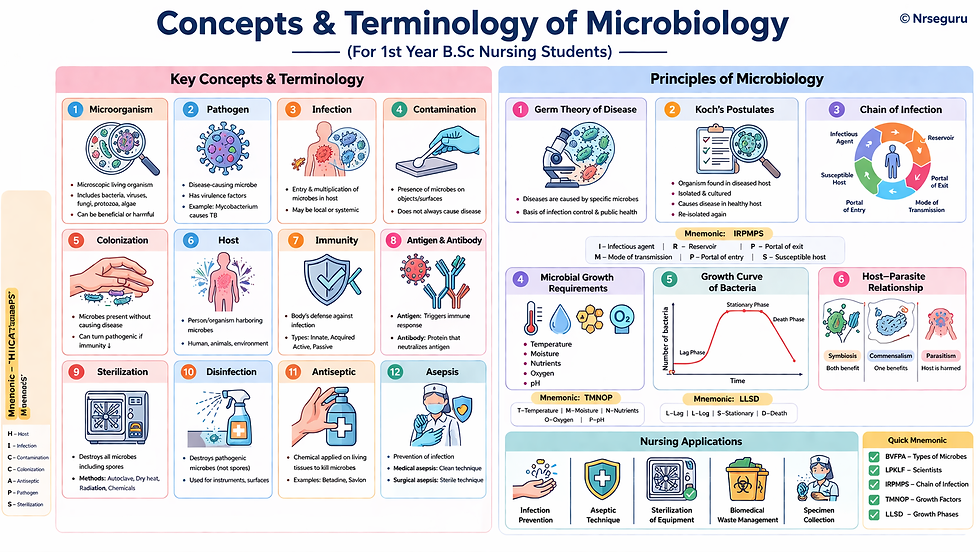
1. Microorganisms (Microbes)
Definition
Microorganisms are microscopic living organisms that cannot be seen with naked eye.
Types of Microorganisms
Type | Description | Example | Disease |
Bacteria | Single-celled prokaryotic organism | E.coli | UTI |
Virus | Non-cellular particle requiring host cell | HIV | AIDS |
Fungi | Multicellular or unicellular | Candida | Candidiasis |
Protozoa | Single-celled eukaryotes | Plasmodium | Malaria |
Algae | Photosynthetic organism | Chlamydomonas | Rare infection |
Characteristics of Microorganisms
Very small in size
Multiply rapidly
Found everywhere (air, water, soil, body)
Some are beneficial
Some cause disease
Normal Flora (Normal Microbiota)
Microorganisms normally present in body without causing disease.
Examples:
Skin bacteria
Intestinal bacteria
Functions of normal flora
Prevent harmful microbes growth
Help digestion
Produce vitamins (Vitamin K, B)
Pathogen
Microorganism capable of causing disease.
Examples:
Streptococcus → throat infection
Mycobacterium tuberculosis → TB
Opportunistic Pathogen
Normally harmless microbes that cause disease when immunity decreases.
Example:
Candida infection in diabetic patient
🧠 Mnemonic – Types of Microorganisms
"BVFPA"
B – Bacteria
V – Virus
F – Fungi
P – Protozoa
A – Algae
2. Infection
Definition
Entry, multiplication and growth of microorganisms in body tissues causing damage.
Types of Infection
Type | Meaning |
Local infection | Limited to one area |
Systemic infection | Spreads throughout body |
Acute infection | Sudden onset |
Chronic infection | Long duration |
Nosocomial infection | Hospital acquired infection |
Opportunistic infection | Occurs when immunity decreases |
Source of Infection
Patient
Environment
Contaminated equipment
Healthcare workers
3. Contamination
Presence of microorganisms on non-living object or body surface.
Example: Contaminated dressing tray
4. Colonization
Presence of microbes without causing disease.
Example: Staphylococcus on skin
5. Host
Organism that harbors microorganism.
Types:
Human
Animal
6. Immunity
Body's ability to resist infection.
Types of Immunity
Type | Explanation |
Innate immunity | Present from birth |
Acquired immunity | Develops after infection |
Active immunity | Body produces antibodies |
Passive immunity | Antibodies transferred |
Example: Mother to baby via breast milk
7. Antigen
Substance that stimulates immune response.
Example: Bacteria toxin
8. Antibody
Protein produced by immune system to fight antigen.
9. Sterilization
Complete destruction of all microorganisms including spores.
Methods:
Autoclave
Dry heat
Radiation
10. Disinfection
Destruction of harmful microorganisms (not spores).
Example:
Phenol
Alcohol
Chlorine
11. Antiseptic
Chemical used on living tissues to destroy microbes.
Examples:
Dettol
Savlon
Betadine
12. Asepsis
Practice of preventing infection.
Types:
Medical asepsis
Clean technique
Example:
Hand washing
Surgical asepsis
Sterile technique
Example:
Operation theatre
🧠 Mnemonic – Infection related terms
"PICASO HAS"
P – Pathogen
I – Infection
C – Colonization
A – Antigen
S – Sterilization
O – Opportunistic infection
H – Host
A – Antibody
S – Sepsis
PART 2 — PRINCIPLES OF MICROBIOLOGY
Principles explain how microorganisms live, grow, reproduce and cause disease.
1. Germ Theory of Disease
States that specific microorganisms cause specific diseases.
Developed by Louis Pasteur and Robert Koch.
Examples:
Microorganism | Disease |
Mycobacterium | Tuberculosis |
Vibrio cholera | Cholera |
Salmonella | Typhoid |
2. Koch’s Postulates
Guidelines to identify disease causing organism.
Criteria:
Organism present in diseased person
Organism isolated and cultured
Cultured organism causes disease in healthy person
Same organism recovered again
3. Chain of Infection
Explains how infection spreads.
Six components:
Step | Description |
Infectious agent | Pathogen |
Reservoir | Place where microbes live |
Portal of exit | Path leaves body |
Mode of transmission | Spread method |
Portal of entry | Entry into body |
Susceptible host | Person at risk |
Example of Chain of infection
TB infection:
Agent → Mycobacterium tuberculosis
Reservoir → infected person
Exit → cough droplets
Transmission → air
Entry → lungs
Host → low immunity person
4. Microbial Growth Principles
Microorganisms grow rapidly under suitable conditions.
Factors affecting growth:
Factor | Effect |
Temperature | Optimum growth |
Moisture | Required for survival |
Oxygen | Aerobic or anaerobic growth |
Nutrients | Provide energy |
pH | Suitable acidity level |
Growth phases of bacteria
Lag phase
Log phase
Stationary phase
Death phase
🧠 Mnemonic – Growth phases
"LLSD"
L – LagL – LogS – StationaryD – Death
5. Principles of Sterilization and Disinfection
Used to control infection.
Sterilization methods:
Physical methods:
Heat
Radiation
Chemical methods:
Ethylene oxide
Formaldehyde
Disinfection levels:
Level | Activity |
High level | kills most microbes |
Intermediate | kills bacteria |
Low level | kills some microbes |
6. Host-parasite relationship
Relationship between microorganism and host.
Types:
Type | Meaning |
Symbiosis | both benefit |
Commensalism | one benefits |
Parasitism | host harmed |
Example:
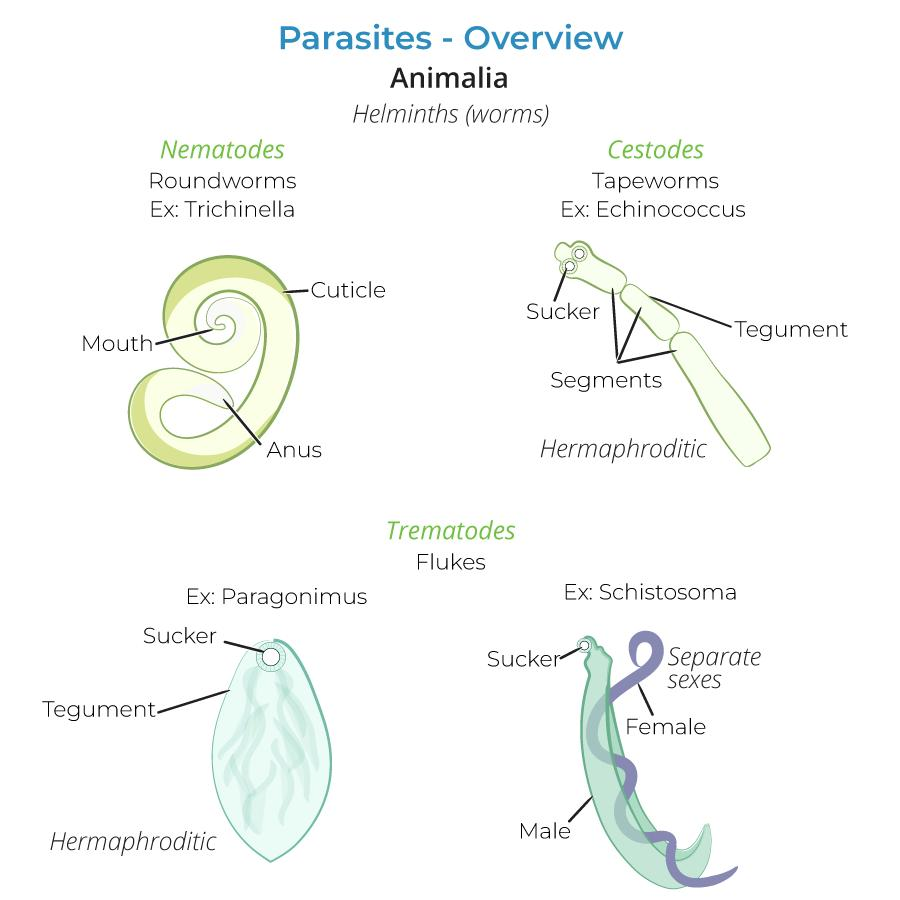
Parasite: Tapeworm
Host: Human intestine
7. Infection control principles
Breaking chain of infection prevents disease.
Methods:
Hand hygiene
PPE use
Sterilization
Isolation
Clinical Importance for Nurses
Nurses must:
Follow aseptic technique
Prevent cross infection
Educate patients
Maintain hygiene
Handle specimens properly
Summary Table
Topic | Key Idea |
Microorganisms | tiny living organisms |
Pathogen | disease causing microbes |
Infection | invasion of microbes |
Immunity | body defense |
Germ theory | microbes cause disease |
Chain of infection | infection spread |
Sterilization | destroys all microbes |

Comments