
🛡️ IMMUNITY – Types, Classification, Hypersensitivity & Immunization
- Apr 16
- 4 min read
B.Sc Nursing Microbiology Notes (INC Syllabus) – Exam Oriented & Mobile Friendly
1. INTRODUCTION
Immunity is the body’s ability to resist infection and protect against harmful microorganisms such as bacteria, viruses, fungi, and parasites.
The immune system identifies foreign substances (antigens) and produces antibodies to destroy them.
Importance in Nursing Practice
Understanding immunity helps nurses to:
Prevent infections
Understand vaccination schedules
Care for immunocompromised patients
Recognize allergic reactions
Manage hypersensitivity conditions
Prevent hospital-acquired infections
Role in Disease Prevention
Vaccination protects against infectious diseases
Immunity reduces severity of illness
Infection control reduces disease spread
2. DEFINITION
Immunity Definition (Exam Ready)
Immunity is the ability of the body to resist and fight against infection and disease-causing microorganisms.
Related Definitions
Term | Definition |
Antigen | Foreign substance that stimulates immune response |
Antibody | Protein produced to destroy antigen |
Immune response | Reaction of body against antigen |
Hypersensitivity | Excessive immune reaction |
Immunization | Process of producing immunity artificially |
3. CLASSIFICATION OF IMMUNITY
Types of Immunity
Main Type | Subtype | Description | Example |
Innate immunity | Natural | Present from birth | Skin barrier |
Acquired immunity | Active | Develops after infection/vaccine | Measles infection |
Acquired immunity | Passive | Antibodies transferred | Maternal antibodies |
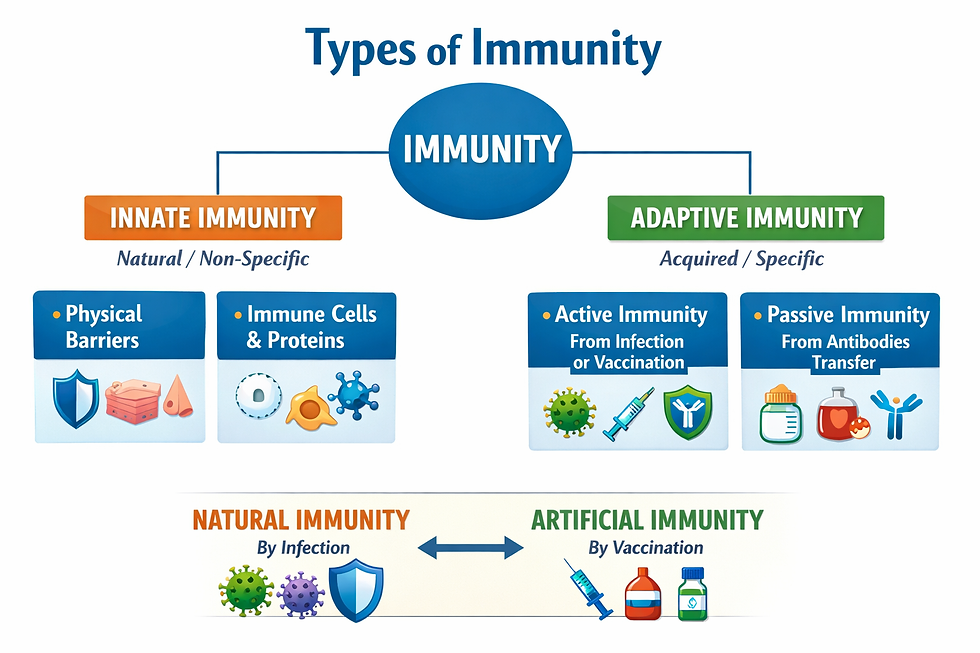
3.1 INNATE IMMUNITY (NATURAL IMMUNITY)
Present at birth and does not require exposure to antigen.
Characteristics
Non-specific defense
Immediate response
No memory
Same response every time
Components of Innate Immunity
Defense | Example |
Physical barrier | Skin |
Chemical barrier | Gastric acid |
Cellular defense | WBC |
Inflammatory response | Swelling |
Examples
Skin prevents entry of microbes
Tears destroy bacteria
Fever destroys pathogens
3.2 ACQUIRED IMMUNITY (ADAPTIVE IMMUNITY)
Develops after exposure to antigen.
Characteristics
Specific response
Memory present
Strong protection
Types of Acquired Immunity
Type | Description | Example |
Active immunity | Body produces antibodies | Vaccination |
Passive immunity | Ready-made antibodies given | Immunoglobulin injection |
3.3 ACTIVE IMMUNITY
Body produces antibodies after exposure.
Types
Natural active immunity – infection exposure
Artificial active immunity – vaccination
Example
COVID infection produces antibodies.
3.4 PASSIVE IMMUNITY
Antibodies transferred from outside.
Types
Natural passive immunity – mother to baby
Artificial passive immunity – immunoglobulin injection
Example
Maternal antibodies via placenta
4. STRUCTURE / COMPONENTS OF IMMUNE SYSTEM
Major organs of immune system:
Organ | Function |
Bone marrow | Produces WBC |
Thymus | Maturation of T cells |
Spleen | Filters blood |
Lymph nodes | Trap microbes |
Tonsils | Protect throat |
Lymph | Transport immune cells |
5. MECHANISM OF IMMUNE RESPONSE (PATHOGENESIS)
Steps of Immune Response
Antigen entry → Recognition → Antibody production → Antigen destruction → Memory formation
Explanation
Microorganism enters body
Immune cells detect antigen
Antibodies produced
Antigen destroyed
Memory cells formed
6. HYPERSENSITIVITY
Definition
Hypersensitivity is an exaggerated immune response causing tissue damage.
Example: Allergy to dust, food, drugs.
Types of Hypersensitivity
Type | Name | Example |
Type I | Immediate | Anaphylaxis |
Type II | Cytotoxic | Hemolytic anemia |
Type III | Immune complex | Rheumatoid arthritis |
Type IV | Delayed | Contact dermatitis |
Type I Hypersensitivity (Immediate)
Occurs within minutes.
Examples:
Asthma
Allergy
Anaphylaxis
Symptoms:
Rash
Swelling
Difficulty breathing
Type II Hypersensitivity (Cytotoxic)
Antibodies destroy body cells.
Examples:
Blood transfusion reaction
Hemolytic disease
Type III Hypersensitivity (Immune Complex)
Antigen-antibody complexes deposit in tissues.
Examples:
Arthritis
Lupus
Type IV Hypersensitivity (Delayed)
Occurs after 24–48 hours.
Examples:
Tuberculin test reaction
Contact dermatitis
7. IMMUNIZATION
Definition
Immunization is process of providing immunity by vaccination.
Types of Immunization
Type | Description | Example |
Active immunization | Vaccine stimulates antibodies | BCG |
Passive immunization | Ready antibodies given | Rabies immunoglobulin |
Types of Vaccines
Vaccine Type | Example |
Live vaccine | BCG |
Killed vaccine | Polio |
Toxoid vaccine | Tetanus |
Subunit vaccine | Hepatitis B |
8. MODES OF IMMUNITY DEVELOPMENT
Natural infection → Antibody production → Immunity
Vaccination → Memory cell formation → Protection
Maternal antibodies → Infant protection
9. CLINICAL MANIFESTATIONS OF IMMUNE RESPONSE
Normal response:
Fever
Inflammation
Antibody production
Hypersensitivity:
Rash
Itching
Swelling
Anaphylaxis
10. DIAGNOSTIC METHODS
Immune system tests:
Test | Purpose |
CBC | WBC count |
ELISA | Detect antibodies |
Antigen test | Detect infection |
Skin test | Allergy test |
Serology | Immune response |
11. PREVENTION AND CONTROL
Methods to improve immunity:
Vaccination
Balanced diet
Exercise
Hygiene
Adequate sleep
Stress control
Hospital measures:
Isolation precautions
PPE use
Sterilization
12. NURSING RESPONSIBILITIES
Nurse role in immunity:
Assessment
Identify infection risk
Implementation
Administer vaccines
Monitor allergic reaction
Education
Teach vaccination importance
Promote hygiene
Documentation
Record immunization history
Emergency care
Manage anaphylaxis
13. COMMON DISEASES RELATED TO IMMUNITY
Disease | Cause |
AIDS | Weak immunity |
Allergy | Hypersensitivity |
Asthma | Immune reaction |
Autoimmune disease | Body attacks itself |
COVID | Viral infection |
14. MEMORY TRICKS (MNEMONICS)
Types of Immunity
"INAP"
I – Innate
N – Natural
A – Active
P – Passive
Hypersensitivity Types
"ACID"
A – Anaphylaxis (Type I)
C – Cytotoxic (Type II)
I – Immune complex (Type III)
D – Delayed (Type IV)
Immune System Organs
"B STLT"
B – Bone marrow
S – Spleen
T – Thymus
L – Lymph node
T – Tonsils
15. CLINICAL RELEVANCE FOR NURSES
Important in:
Vaccination programs
Allergy management
Infection prevention
Post exposure prophylaxis
Immunocompromised patient care
Pediatric vaccination schedule
Examples:
Hepatitis B vaccine for nurses
COVID vaccination
TT injection during pregnancy
16. EXAM KEY POINTS
Immunity protects body from infection
Two main types – innate and acquired
Active immunity produces antibodies
Passive immunity provides ready antibodies
Hypersensitivity is exaggerated immune response
Immunization prevents disease
Vaccines stimulate antibody production
Nurses play important role in vaccination
17. SUGGESTED DIAGRAM / FLOWCHART
Students should practice:
Types of immunity chart
Antigen-antibody reaction diagram
Hypersensitivity types table
Immunization flowchart
18. QUICK REVISION TABLE
Concept | Key Point |
Immunity | Protection against disease |
Innate immunity | Present at birth |
Acquired immunity | Develops after exposure |
Active immunity | Antibodies produced |
Passive immunity | Antibodies given |
Hypersensitivity | Excess immune reaction |
Immunization | Vaccine protection |
19. 60-SECOND REVISION CARD
Immunity protects body from infection.
Types: Innate immunity-Acquired immunity
Acquired immunity: Active immunity-Passive immunity
Hypersensitivity: Excess immune reaction
Immunization: Protection by vaccine
Examples: BCG-Polio-Tetanus
Nurse role: Vaccination-Education-Infection prevention

Comments