
Low Birth Weight Babies
- Apr 2
- 3 min read
1. INTRODUCTION
Low Birth Weight (LBW) is defined as birth weight less than 2500 grams (2.5 kg), irrespective of gestational age.
It is a major public health problem, especially in developing countries.
LBW babies contribute significantly to neonatal mortality and morbidity.
It includes:
Preterm babies (born before 37 weeks)
Intrauterine Growth Restriction (IUGR) babies
2. TYPES of LBW
A. Based on Birth Weight
Low Birth Weight (LBW): < 2500 g
Very Low Birth Weight (VLBW): < 1500 g
Extremely Low Birth Weight (ELBW): < 1000 g
B. Based on Gestational Age & Growth
1.Preterm LBW
Born before 37 weeks
Weight low due to prematurity
2.IUGR (Small for Gestational Age - SGA)
Full term but growth restricted
Weight low for gestational age
3.Combined (Preterm + IUGR)
3. CAUSES OF LBW
A. Maternal Causes
Anemia
Malnutrition
Pregnancy Induced Hypertension (PIH)
Chronic diseases (diabetes, heart disease)
Infections (TORCH, malaria)
Smoking, alcohol, drugs
Teenage pregnancy / elderly mother
Short birth interval
B. Placental Causes
Placental insufficiency
Placenta previa
Abruptio placenta
Poor placental blood flow
C. Fetal Causes
Congenital anomalies
Multiple pregnancy (twins/triplets)
Intrauterine infections
Genetic disorders
4. CLINICAL MANIFESTATIONS
General Appearance
Weight < 2.5 kg
Thin, wasted body
Loose skin, less subcutaneous fat
Large head compared to body
Behavioral Signs
Weak cry
Poor sucking reflex
Lethargy
Reduced activity
Physiological Problems
Hypothermia (due to poor fat stores)
Hypoglycemia (low glucose reserves)
Respiratory distress (especially in preterm)
5. COMPLICATIONS
A. Immediate (Neonatal Period)
Hypothermia
Hypoglycemia
Respiratory Distress Syndrome (RDS)
Neonatal jaundice
Sepsis (infection)
Feeding difficulties
Apnea
B. Long-Term Complications
Growth retardation
Delayed milestones
Learning disabilities
Behavioral problems
Chronic diseases in adulthood (e.g., hypertension, diabetes)
6. MANAGEMENT OF LBW
A. General Principles
Maintain warmth
Ensure adequate nutrition
Prevent infection
Monitor closely
B. Thermal Care
Radiant warmer/incubator
Kangaroo Mother Care (KMC) (most effective)
Avoid exposure to cold
C. Nutritional Care
Early breastfeeding (within 1 hour)
Exclusive breastfeeding
Tube feeding if baby cannot suck
IV fluids if necessary
D. Prevention & Treatment of Complications
Monitor blood glucose → treat hypoglycemia
Oxygen therapy for respiratory distress
Antibiotics for infection
Phototherapy for jaundice
E. Kangaroo Mother Care (KMC)
Skin-to-skin contact
Improves:
Temperature control
Weight gain
Breastfeeding
Reduces infection & mortality
F. Monitoring
Daily weight
Temperature
Feeding pattern
Urine output
Signs of danger (apnea, cyanosis)
7. PREVENTION OF LBW
Proper antenatal care
Maternal nutrition
Iron & folic acid supplementation
Control of maternal diseases
Avoid smoking/alcohol
Adequate birth spacing
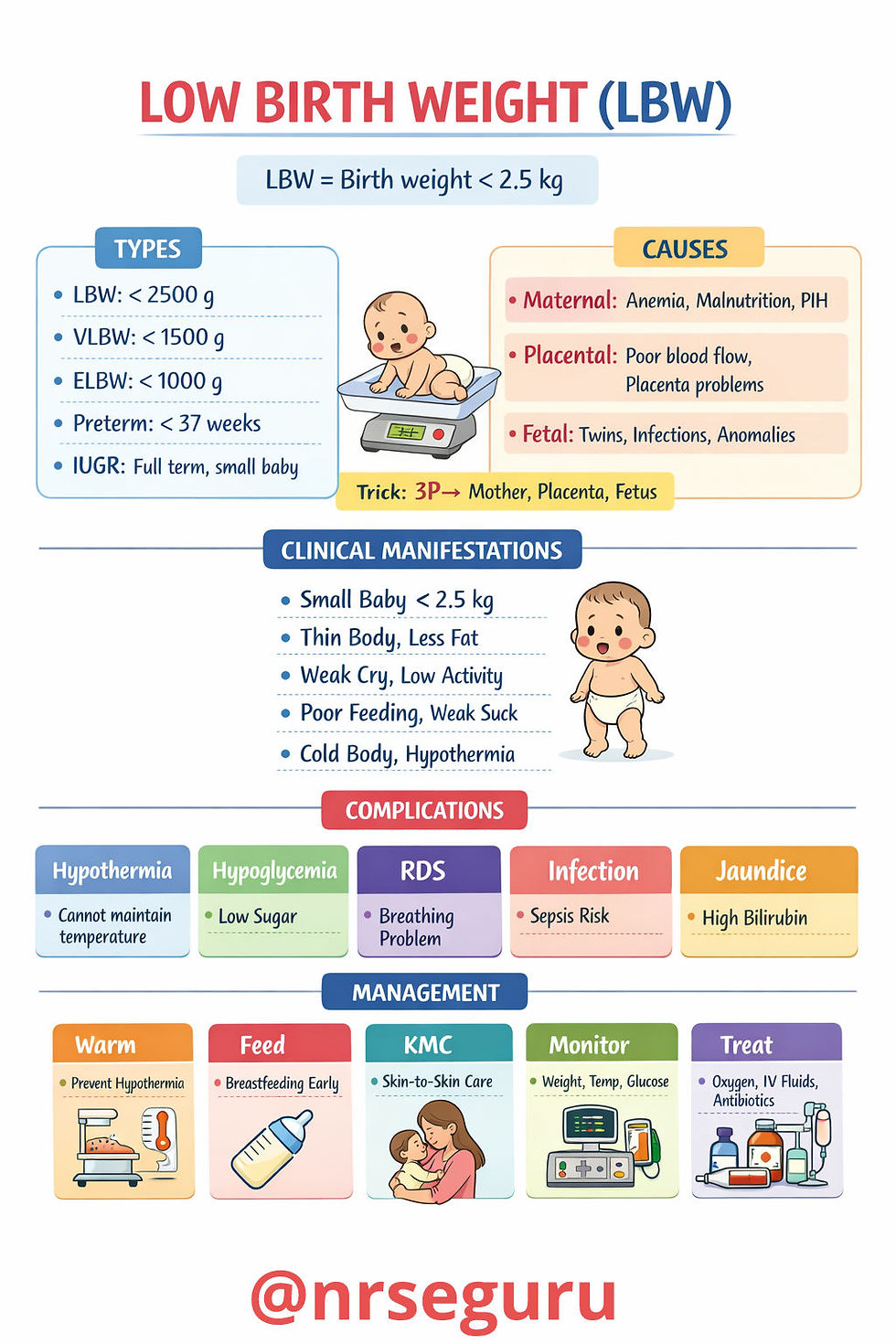
🚀Here’s a short “exam trick” version for low Birth Weight Babies — super quick points you can remember
🚀Here’s a set of 07 MCQs on Low birth weight Babies for practice:
1. Low Birth Weight is defined as:
A. < 3 kg
B. < 2.5 kg
C. < 2 kg
D. < 1.5 kg
✅ Answer: B. < 2.5 kg
2. Very Low Birth Weight (VLBW) refers to:
A. < 2500 g
B. < 2000 g
C. < 1500 g
D. < 1000 g
✅ Answer: C. < 1500 g
3. Major cause of LBW in developing countries is:
A. Genetic factors
B. Maternal malnutrition
C. Trauma
D. Drugs
✅ Answer: B. Maternal malnutrition
4. Which is NOT a cause of LBW?
A. Multiple pregnancy
B. Maternal anemia
C. Good nutrition
D. Placental insufficiency
✅ Answer: C. Good nutrition
5. Most common complication of LBW baby is:
A. Hypertension
B. Hypothermia
C. Obesity
D. Fracture
✅ Answer: B. Hypothermia
6. Best method to maintain temperature in LBW baby is:
A. Incubator only
B. Kangaroo Mother Care
C. Cold sponging
D. Isolation
✅ Answer: B. Kangaroo Mother Care
7. LBW babies are at high risk of:
A. Hyperglycemia
B. Hypoglycemia
C. Hypertension
D. Hypercalcemia
✅ Answer: B. Hypoglycemia
Comments