
Social Structure
- Jul 13, 2025
- 3 min read
Definition:
Social structure refers to the organized pattern of social relationships and institutions that together compose society. It provides a framework within which individuals and groups interact.
Basic Concepts
1.Society:
A society is a group of people who share a common culture, territory, and social institutions.
Characteristics:
Shared customs and values
Social interaction
Organized roles and norms
Continuity through generations
Community:
A community is a localized social group with common interests, shared values, and close social interactions.
Examples: Villages, neighborhoods
3.Association:
An association is an organized group of people formed to achieve a specific purpose.
Examples: Nursing council, Red Cross, cooperative societies
4.Institution:
An institution is a stable, established pattern of behavior organized around particular purposes.
Examples: Family, education, religion, healthcare
Individual and Society:
The individual and society are interdependent.
Society shapes individual behavior through norms, values, and social roles.
Individuals contribute to societal development through participation and innovation.
Personal Disorganization:
This refers to a breakdown in an individual’s ability to function normally within society due to:
Mental illness
Substance abuse
Family disruption
Poverty
Loss of role or identity
Social Group
Meaning:
A social group is a collection of individuals who interact and share a sense of unity or belonging.
Characteristics:
Mutual awareness
Interaction
Common interests
Norms and values
Group identity
Classification:
Primary Group – close, personal relationships (e.g., family, close friends)
Secondary Group – formal, impersonal relationships (e.g., workplace)
In-groups and Out-groups
Formal and Informal Groups
Social Processes
Definition:
Social processes are the patterns of interaction between individuals and groups in society.
Types and Forms:
Co-operation:
Working together for a common goal
E.g., Nurses and doctors working in a health team
Competition:
Struggle between individuals or groups for limited resources
Can be constructive or destructive
Conflict:
Direct opposition or struggle due to differences
May be personal, racial, religious, political
Accommodation:
Adjustment between conflicting individuals or groups
Maintains peace and coexistence
Assimilation:
Blending of two cultures to form a new one
E.g., migrants adapting to a new community
Isolation:
Separation of an individual or group from social contact
Leads to loneliness and psychological issues
Socialization
Definition:
Socialization is the process by which individuals learn and internalize the norms, values, behaviors, and skills needed to function in society.
Characteristics:
Lifelong process
Develops personality
Builds social identity
Promotes social integration
Process:
Learning through interaction
Role-playing and imitation
Reinforcement and discipline
Agencies:
Family (primary agent)
Peers
School
Mass Media
Religious institutions
Healthcare institutions (for nurses)
Social Change
Definition:
Social change is the transformation of culture, behavior, social institutions, and structure over time.
Nature:
Continuous and inevitable
May be slow or rapid
Affects all aspects of life
Process:
Innovation and discovery
Cultural diffusion
Technological advancement
Social movements
Legislation
Role of Nurse in Social Change:
Health education and awareness
Advocacy for community health
Promoting hygiene and disease prevention
Influencing behavioral change through outreach
Supporting government health schemes
Structure and Characteristics of Communities
1.Urban Community:
Dense population
High literacy and employment
Better healthcare and facilities
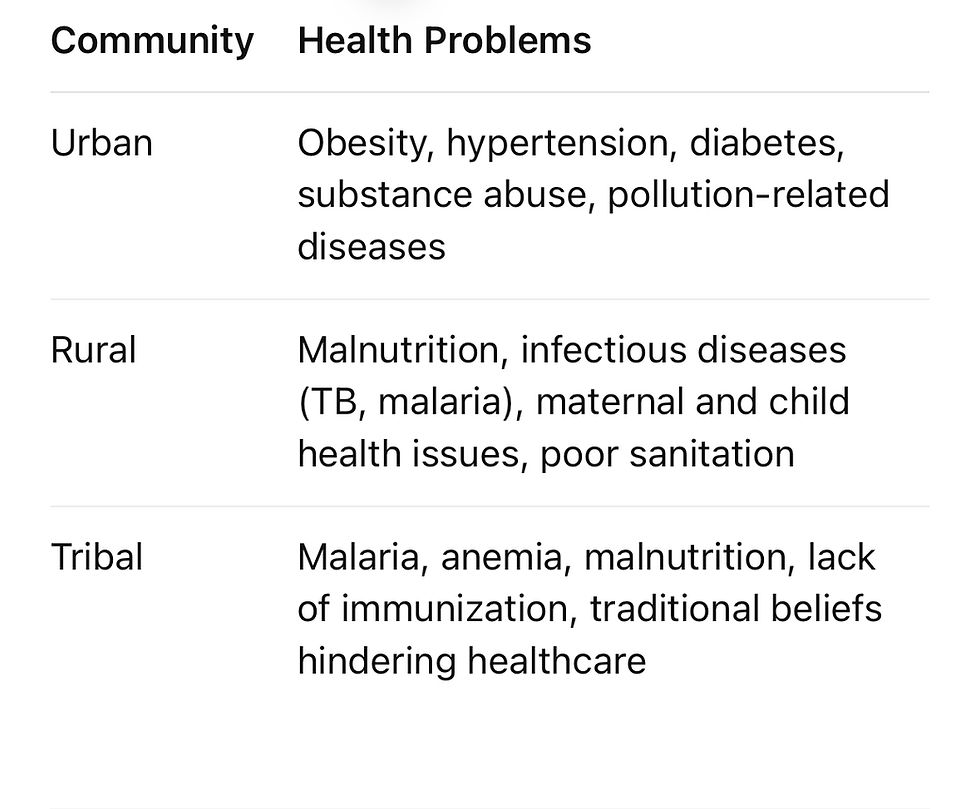
Problems: Pollution, stress, lifestyle diseases, crime
2.Rural Community:
Agricultural-based economy
Low population density
Close social relations
Problems: Limited healthcare access, malnutrition, poor sanitation
3.Tribal Community:
Indigenous lifestyle and customs
Forest-based economy
Strong community bonding
Problems: Superstitions, isolation, lack of education and healthcare
Major Health Problems in Communities
Importance of Social Structure in Nursing Profession
Understanding Patient Background: Helps in culturally sensitive care
Effective Communication: Aids in developing trust and rapport
Community Health Nursing: Essential for planning interventions
Health Education: Tailored to social background and beliefs
Promoting Social Justice: Addressing inequality and advocating for marginalized groups
Multidisciplinary Collaboration: Work efficiently with other healthcare professionals
Conclusion
Knowledge of social structure and social processes equips nurses to deliver comprehensive and culturally competent care. It also enhances their role as health educators, community leaders, and agents of social change.
Comments