
Uterine polyps
- Apr 1
- 2 min read
📚INTRODUCTION
Uterine polyps are common benign overgrowths of endometrial tissue that project into the uterine cavity.
They are mostly seen in reproductive and perimenopausal women and may cause abnormal uterine bleeding.
♦️DEFINITION
A uterine polyp is a localized benign growth of endometrial tissue attached to the uterine wall by a broad base or stalk.
⭕CAUSES
(Exact cause not fully known, but related to)
Hormonal imbalance (↑ estrogen)
Endometrial hyperplasia
Chronic inflammation
Genetic factors
🔷RISK FACTORS
Age (40–50 years)
Perimenopause
Obesity
Hypertension
Tamoxifen therapy
Hormone replacement therapy (HRT)
PCOS
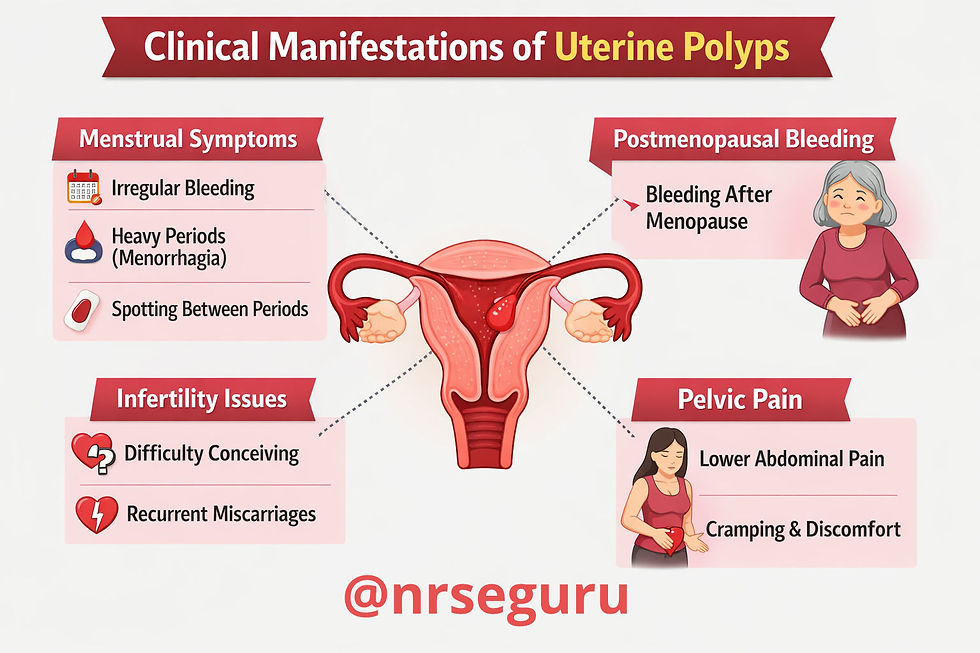
🔶 CLINICAL MANIFESTATIONS
🧪DIAGNOSIS
Clinical Evaluation
History of abnormal bleeding
Pelvic examination
Investigations
Ultrasound (USG) → first-line
Transvaginal ultrasound (TVS) → more accurate
Hysteroscopy → gold standard (direct visualization)
Endometrial biopsy → rule out malignancy
Sonohysterography → better cavity view
⚡COMPLICATIONS
Anemia (due to bleeding)
Infertility
Recurrence
Rare malignant transformation
🏥MANAGEMENT
1. Conservative Management
Observation (small, asymptomatic polyps)
2. Medical Management
Hormonal therapy (progesterone)
Limited role (temporary relief only)
3. Surgical Management
Polypectomy (removal of polyp) → treatment of choice
Hysteroscopic removal (preferred method)
Curettage (D&C)
Hysterectomy (rare, severe cases)
👨🏻⚕️NURSING MANAGEMENT
Assessment
Monitor bleeding pattern
Assess for anemia
Check vital signs
Interventions
Administer prescribed medications
Prepare patient for hysteroscopy/polypectomy
Post-procedure care
Maintain hygiene
🏥HEALTH EDUCATION
Importance of follow-up
Report abnormal bleeding early
Maintain healthy weight
Medication compliance
🚀Here’s a short “exam trick” version for Uterine Polyps— super quick points you can remember :
Introduction: Benign growth of endometrium projecting into uterine cavity
Definition: Localized overgrowth of endometrial tissue attached by base or stalk
Causes: Increased estrogen, endometrial hyperplasia, inflammation
Risk factors: Age 40–50, obesity, hypertension, tamoxifen use
Clinical manifestations: Irregular bleeding, menorrhagia, spotting, infertility
Diagnosis: USG, TVS, hysteroscopy (gold standard), biopsy
Complications: Anemia, infertility, recurrence, rare malignancy
Management: Observation (small), hormonal therapy, polypectomy (main treatment)
🚀Here’s a set of 07 MCQs on Uterine Polyps for practice :
1. Uterine polyp is:
a) Malignant tumor
b) Benign growth of endometrium ✅
c) Infection
d) Hormonal disease
2. Most common symptom of uterine polyp:
a) Amenorrhea
b) Irregular uterine bleeding ✅
c) Fever
d) Weight gain
3. Gold standard for diagnosis of uterine polyp:
a) X-ray
b) Ultrasound
c) Hysteroscopy ✅
d) CT scan
4. Uterine polyps are mainly associated with:
a) Decreased estrogen
b) Increased estrogen ✅
c) Low progesterone only
d) Infection
5. Risk factor for uterine polyp:
a) Young age
b) Obesity ✅
c) Smoking only
d) Trauma
6. Main treatment of uterine polyp:
a) Antibiotics
b) Antifungals
c) Polypectomy (removal) ✅
d) Bed rest
7. Complication of uterine polyp:
a) Hypertension
b) Infertility ✅
c) Asthma
d) Diabetes
Comments